Welcome to the comments, opinions and reflections of an 8th year Health, PE and OUED teacher. I have taught in Auckland, Adelaide and mid 2023 sees the move to Levin. Feel free to comment or contact me through Twitter, always keen to connect and share!
Throughout this year, as previously posted about, I have been completing research to write a dissertation. Simplistically, I was investigating the potential for blogging within Year 11 PE. On Monday afternoon I handed in my 32 page dissertation and it felt amazing! The past two years have been intense teaching full time and studying part time, but I'm glad to get through. I learnt a lot about myself, my practice and technology within the classroom. If anyone would like to read it, you can access it here!
The staff at school were encouraged to reflect on the Manaiakalani cluster-wide pedagogy Learn, Create, Share, as well as the core of the cluster. I decided to write my reflections based on one of learners from my study, as this has been at the forefront of my mind. The study demonstrated the potential blogging has in education, particularly in specialised disciplines like PE. The students became more reflective, their literacy (traditional and digital) increased and there was more peer to peer teaching. When implementing blogging within my teaching and learning in the future, I need to provide a structure for students, ensure they understand the purpose of the blogging, and encourage students to provide further feedback and feedforward as comments on blogposts for their peers (evident from my research and literature).
Overall, it has been really difficult reading dozens of academic articles, writing late at night and including a pedagogical tool I only knew about from writing my own posts! But, my inquiry/dissertation has shown me how powerful writing blogs can be for learners, so I hope to include in future classes. In 2018, I am interested to explore literacy in Health and PE as my inquiry. I have noticed many of our NCEA assessments are evidence towards literacy credits, but some of the students struggle to write. Although their content may be correct, sometimes I struggle to read the students' assessments as they have poor spelling or grammar, or a lack of paragraphs. Therefore, although one hurdle and challenge is over, I am looking forward to more challenges next year!
I am currently feeling under the pump, like I'm barely keeping afloat. Not only have I been battling a head cold and it is the end of the term, I am trying to tackle my data for my dissertation. This post is a quick update with student feedback and major findings!
Across the whole class I was interested to know their opinions about blogging within PE, and how/if blogging effects their learning in PE. A quick Google Form showed interesting results. These graphs are a little off, because I asked students to complete the Form at the start of Term 2 and then again at the end of Term 2, so some students responses changed. However, they are good visuals for immediate feedback.
Students were given four questions, 1 representing disagree and 4 representing agree. After identifying their position on the scale, the students were asked to give a brief explanation for their position.
Enjoyment of blogging:
Half of the class enjoy blogging and half do not. What interested me was that the scale is heavily tipped towards enjoyment though. Some of the comments the students made were:
- "Because blogging is alright and it can help me for my assessment but it can get annoying at times if we do it too much."
- "I gave a 2 because I don't think what we learn in one particular class needs to be blogged to the public for every topic or session of p.e we have."
- "I enjoy blogging because it help me to remember the things we've leant. I also enjoy blogging because I can get feedback from not only the teacher but also from my peers in the class."
Blogging supports learning:
I was pleased to see nearly two thirds of the students thought blogging was effective/helpful for their learning. Upon reflection, it would have been useful to have discussions with individual students about their comments, to determine what students specifically found effective/useful (or not).
- "It helps me be able to explain what we've learnt so far and how to present it to people".
- "Blogging has helped to support my learning in PE because when I am absent I can always check everyone's blog on what they've learnt when I was absent. Therefore I can catch up with the class and be up to date".
- "Because it can improve my writing".
Blogging is challenging:
I think this question may have been too broad for the students, suggested by the variety of their responses. If I was to redo the Form, I think I would break down the four sections with subquestions, to specify what students may have found challenging.
- "It's hard to see if I'm improving".
- "It can be hard when I want my writing to be a good piece of work and when we have a time frame to complete it in. I find it good challenging but not when I'm under pressure".
- "Sometimes blogging is challenging because there'll be times where I just don't know how to start my blog post, so I'm wasting time trying to know how to start my blog".
Blogging helps with feedback/feedforward
This graph positively surprised me, as majority of the students consider blogging to be helpful for progression of learning. On the flip side, there were also a large proportion of students who didn't think blogging supported their feedback and feedforward. One thing I am exploring a little is how to give effective feedback, a skill many of our students are developing. Then, how to use feedback to grow.
- "Because it gives people more ideas & to improve".
- "Because we can get feedback and feed forward from other people around the world, not just people in our class".
- "Not really because I don't read comments on my blog and no one really gives me feedback or feed-forward on what's on my blogs".
So where am I at now?
I am focussing on three specific students and their comments and blogposts. These are coincidentally the top academic students in my class (these are the students who gave consent for me to use their data for my studies). The major themes/findings of my intervention from these three students are; blogging helps me as their teacher to identify gaps in students' knowledge, over time students became more reflective within their posts, students began to integrate feedback into future posts, and in class discussions/peer teaching increased.
I am currently completing my second assignment for my Summer School course, which is somewhat interesting. Our task is to find a list of blogs and provide a summary of them, choose three blogs to compare and contrast, and then determine which of the three I will follow and read regularly (justified and backed up with research). So, I have spent hours skimming through blogs the past few days, and not felt guilty about it as it was part of an assignment! For anyone interested, here is the list of blogs I put together, which I am interested in exploring further. Definitely not to say there aren't more, there are so many amazing educators blogging!
Amongst my scrolling through heaps of blogposts I wish I could engage with and respond to more, I found Lesson Planning for Technology Use in PE (PEGeek). I could not skim past this one easily! Although the layout suggested is incredibly simple, it has definitely taken time to develop, because it is really in depth. Although I would not complete a lesson plan this in depth for every single lesson, as it would be super time consuming, I think I would like to fill out a few throughout the year.
I really like how the plan really makes you think about why you are including technology, whether it is for the students or the teacher, and whether it is something new or something you are including just for the sake of it. I am wanting to include more technology within my practice, especially apps, but I am unsure how and what to include. Alongside the copious suggestions on the PEGeek blog about what apps to incorporate in PE, this lesson plan really encourages reflection as to why the technology is appropriate for the given task, because I think it is important to not just include technology just to include technology (this is Substitution on the SAMR model for sure!).
Something I had not really considered whilst planning before, was how my lessons were developing students' 21st century skills. The lesson plan offered identifies four key skills students need to be developing in school, which align closely with the Manaiakalani pedagogy of Learn, Create, Share - they are Critical Thinking, Creating, Communication and Collaboration. Even though it seems pretty obvious we should be providing opportunities for students to develop these skills, I feel unless we actually step back and think about whether they are having opportunities (as the lesson plan encourages), then they probably aren't, at least not as often as they could be.
A final point about my liking of this lesson plan, is the idea of the hook, the engagement. Again, it seems so obvious to draw in the learners, to engage or hook them from the start, but I know I am guilty of not having this hook, and then attempting to reel them back in. I want to have more hooks this year! Which aligns closely with Manaiakalani - The Hook From Heaven.
Very excited to read through more posts, and find more gems like this one!
A huge part of conducting research is applying for, and being granted ethics. Research needs to be ethical in order to be carried out, and supposedly approval takes a substantial amount of time. Many from the previous MDTA cohort, and my friends who have carried out their postgrad, have complained to me about the hideous process! However, we are considerably lucky that ethics is, hopefully, going to be granted to our cohort together.
This morning's job was to get the lowdown from the Ethics Team from uni about why application for ethics is incredibly important, and how they are able to assist you along the way. Although unlikely in our studies, there is a possibility to cause harm, long term damage, or affect the participants or researchers, but the aim for ethics is to minimise the likelihood of harm as much as possible. Check out the sketchnote I created as we were given the presentation this morning.
We were then given the difficult task to create an umbrella ethics application to submit together. As expected, this was difficult as we all have very different studies, thus have different methodologies, parameters, samples etc. We came to somewhat of an agreement by the end of the discussion, many conforming to the rest of the group in order to meet the blanket application.
Although I still need to do a bit of thinking in the next week or so, my hope is my research will investigate student and teacher (myself) perception of the impact of blogging on learning, in my Year 11 PE class. I have a bit to redevelop after this morning, to fit under the ethics proposal, but I am both petrified and excited for what is to come! What this space...
We explored some theories of the relationship between technology and society this afternoon. A thought-provoking question to think about is who has the power over the other - technology or society? I found this incredibly interesting to think about, and also quite scary.
It frightens me how strongly people feel technology is 'taking over' society. How technology is seen to have power over our lives, and every aspect of our lives. Having this opinion and real fear, that technology is a controller of what people do, is referred to as technocracy. If people seriously deem this to be true, and see no place for technology in society, particularly education, I fear how disadvantaged these citizens, and potentially their children are. As discussed in the Horizon Report and the Future Focused Learning in Connected Communities, both forecasting what is to come in education, teaching and learning, a large component is the need to develop 21st century learners. I always wonder who determines what these are, and who determines a 21st century learner, but a huuuuuge aspect is the need to be comfortable, confident and connected digitally.
After talking through the various groups of people/stakeholders and how they view the power relationship between technology and society, I started to think about how I feel, where I fit. I think I come under the 'soft technological determinism' notion. This is the idea that technology influences and is influenced by society. A mutual relationship, where one impacts on the other.
The scary reality though, is what will technology be like in 2, 5, 10 years - who will be in power then?
Our focus for day 3 today looked at Learning Design, and beginning to think how our classroom environment (physical and digital) impacts on the learner's experiences.
One theoretical framework which offers how digital technology may impact on teaching and learning is the SAMR model developed by Dr. Ruben Puentedura. He developed the SAMR model, for teachers to analyse and evaluate how technology is used in their classroom. Simply, Substitution is when there is no great affordance of using technology for something, as it is simply replacing pen/paper or hardcopy, such as using the Calculator app, Googling the definition of something or writing a list. Moving through to the Redistribution component of the model, this is when technology completely reforms a task or learning, things which previously could not be done. For instance, movie making, multi-modal pages or blogs. Although difficult to distinguish between the middle components, the below questions help.
Our task to review this model was to create a building. with building blocks. We were split into two groups and needed to brainstorm examples of things we can do within our classes then identify which component of SAMR it related to. Each example/sticky note we came up with, we were given a building block to stick it on. So, the more ideas we had the more blocks we were able to build our building with! I really enjoyed this activity as it was engaging, competitive, revision and fun. I felt so comfortable with the model after this activity. The two groups then displayed their buildings, by letting the marble loose!
Other frameworks/models we explored were ADDIE and Carpe Diem, as below. I found Carpe Diem relatable as the core focus is students feeling welcome, familiar, comfortable and supported within their classroom environment, in order for effective learning to occur. Two more days to go!
Day 2 at Summer School was based around the concept of affordances of technology.
We started by brainstorming our ideas of what technology affords the classroom environment, given two minutes to list each idea on individual sticky notes. We then needed to group the affordances into alike ideas. This process was incredibly interesting because many 'groups' formed incredibly quickly, and some were considerably large (e.g. the affordance of creativity) and others were very small (e.g. assessment). Our understandings of affordance and how we are afforded by the devices our students are exposed to were gigantic!
Cope and Kalantzis (2015) represent their ideas of what technology affords teachers and learners with the below diagram, which we pulled apart in class today. In the Manaiakalani cluster, we are familiar with many of these ideas, particularly ubiquitous learning, multimodal meaning and recursive feedback. I would like to increase my students' ability to have access to their learning anywhere, anytime this year though, by the inclusion of blogging, as well as having greater accessibility to their learning.
I believe collectively our school and cluster are en route to familiarity and confidently addressing and including the other ideas, but specifically I am interested in the affordance of metacognition. Having the critical awareness of one's thoughts and understandings, and the ability to examine one's thoughts and understandings is complex, but an incredibly useful skill. I hope I provide my students with ample opportunities to have open-minds, to think about others ideas and opinions and then be able to challenge them and their own ideas and opinions in a positive, thought-provoking way. However, I do feel students need to be offered more time to actually think about their thinking, which is where rewind-ability and reversibility of knowledge and learning may come in.
Although there are clearly multiple affordances of technology, "there is nothing inherent in technology that automatically guarantees learning" (John & Sutherland, 2005). Thus, we need to remember technology is a tool for learning, not a replacement of it.
And I'm back! After a few weeks skiing in Japan, we got back into it today, starting our Summer School block course.
In preparation for the full on week, we were given nine readings to read and create thought provoking questions for prior to arrival. Each of us were then required to create an activity based on one of the readings, to share with our peers today.
I thought this was a great way to put the research into practice, pulling out some of the key ideas from the text. Particularly when it is beautiful outside and we are still in holiday mode, it has been really difficult taking in the texts, as they are quite long and full on. The activities today were a fantastic way to revise what we had already learnt and pick up some other bits and pieces others had taken away from their reading which we may have missed among some of the jargon.
I kicked off the day with my activity first. My article (Kirschner & Merrienboer, 2013) was really interesting, and I was thankful I easily thought of some activities. If you would like to read it, click here. Check out my basic lesson plan too.
I began with a simple game of Chinese Whispers in two small groups, and then the class came together to play. When they were in small groups, there was slight error from the first person to the last, but considerable error between the first and last person when the class were together as a whole. Similarly, there are many legends in education, which we have come to believe true, however, how does one know if that 'idea' is credible? Correct? Made up? Or if what we know it to be now, is even remotely related to the initial idea years ago? The article explores three apparent legends, which I created three small activities for.
The class was split into two groups via email, then given instructions in person. Group 1 had three questions to answer (see the screenshot of the Google Form) in two minutes. Group 2 answered the same questions, but needed to listen to music and engage in an online chat at the same time as answering them. As expected, generally the students who were multitasking (Group 2) had shorter answers than those in Group 1, as you can see below, because of the divided attention between three things. This does not mean to say their answers are of any less quality, however they were attempting to do multiple things at once, so spent less time answering the questions. Legend 1 suggests students are digital natives, thus always need digital technology, and because they have technology all the time, they are effective and efficient multitaskers. This simple activity suggested otherwise.
Group 1
Group 2
Everyone were then asked to push three things of different weights, with the same force. Very quickly, they could see that the greater the force applied to an object, the further it moved, but if the same force was applied to different weights, the lighter object would move further. I then told them this is related to Newton's 2nd Law of Motion: The Law of Acceleration. To follow up students watched the below clip from 0.33-1.05, explaining the law a little further. To conclude, and revise what they had just learnt, the class were asked to record a brief description in their own words of what Newton's 2nd Law is, and then listen to a peers recording. I followed up with some probing questions and explained the relevance to the three learning styles many are familiar with - legend 2; students can be categorised into kinaesthetic, auditory or visual learners. Because of this widespread belief, many teachers, myself included, attempt to include a variety of activities to cater for these learning styles, when in fact no one can be boxed into one style of learning.
Finally, I gave everyone two minutes to find as many songs as they could which included my name in the lyrics. As expected, a few immediately had the country or the state return from their search, many chose the first link returned in their search, and most had visited three or more websites. To my surprise no one knew about search functions in Google such as -country or "Georgia in lyrics", to control and reduce Google's response a little. This was perfect to highlight we all have different understandings of how to effectively and efficiently research, and this was something huge they didn't know. Therefore, our students must know little about how to research effectively. So, legend 3 emphasises students need to take control of their own learning and be self educators, but how can they do this if we aren't even knowledgeable on how to find answers to things we are unsure of?
We have four more days of summer school including a reading and then it is game on with planning next week. Really excited to see the kids!
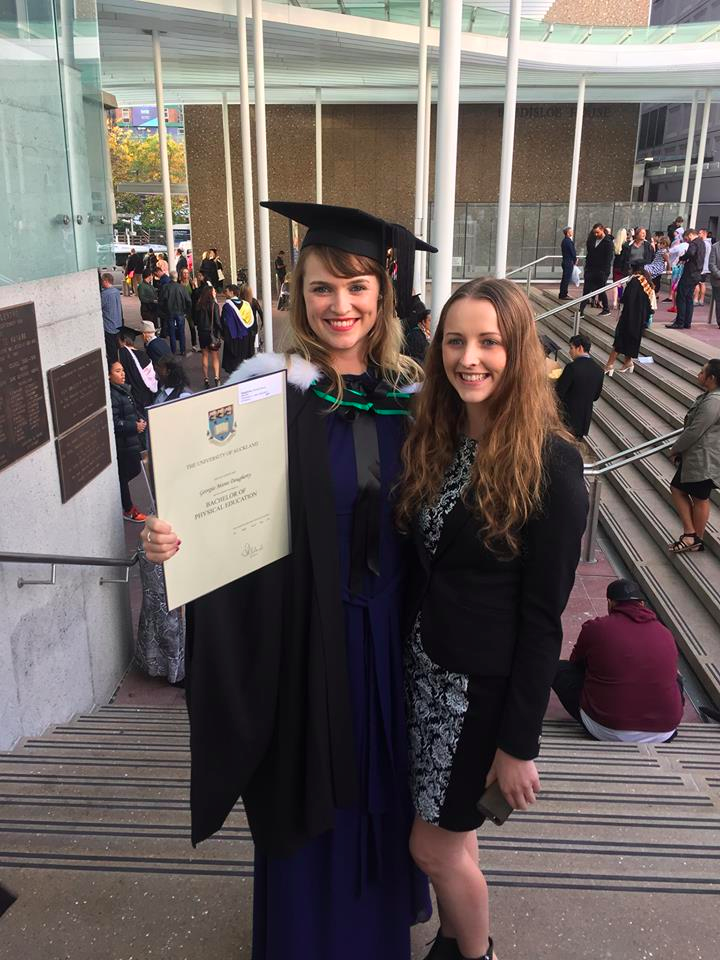
After giving 110% for 4 years, today I graduated! I can now officially say I have a degree, some call it an expensive piece of paper!
I graduated with a Bachelor of Physical Education with my BPE whanau. I felt nervous and excited about being capped in front of hundreds and hundreds of people, but I didn't trip thankfully!
I begun the day with my family and partner for breakfast. We then taxied into Auckland City to The University of Auckland to get some photos and prepare for 'the walk'. I really enjoyed the walk down to Aotea Square with my cohort, it was nice to catch up with them all and celebrate our success together.
After the walk some of us went out for brunch before the ceremony. Although the ceremony itself was a little tedious, as I was number 477, I am glad that I went. I was proud of myself and my friends, and my family was proud of me. We wandered down to the Viaduct for some family photos and a toast.
I celebrated in the evening with some expensive champagne, good food and amazing company. Now to get through my Honours...
Currently I am writing an assignment about motivating my students, I think I need to take a leaf out of my own book! But what is motivation?
Today I lost half of my weekend to be at a block course at uni, however I really enjoyed the day.
The morning session was about unpacking some of the readings to get the most out of them we could. We were split into groups based on which reading we had read and then our task was to collaboratively summarise the article into one paragraph. From there we unpacked a reading we hadn't read and created a Digital Learning Object (DLO) to reflect/teach what the reading was about, using another groups summary as reference.
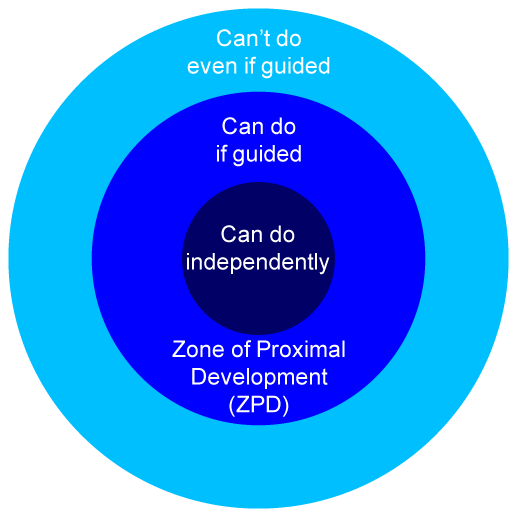
My group created the below Google Drawing as our DLO, to illustrate Vygotsky's Zone of Proximal Development. I visioned the ZPD similar to running. We can run on the flat on our own, we need assistance to run uphill, however for many of us rock climbing on our own is way out of our reach and we could fall. Thus, the blue character (myself) is the learner and the others are the teacher and the helping hands.
Our afternoon session intrigued me considerably. We discussed and debated the idea of knowledge and skill. Are knowledge and skill learnt individually, collectively or does one happen as a result of the other? I believe knowledge is learning and discovering new information, and skill is the opportunity to implement, analyse and build upon knowledge. However, I also think knowledge and skill develop as a result of one another both directly and indirectly. If you are interested in this debate, or wish to ponder further, consider reading Greeno, Collins and Resnick's discussion.
(Greeno, J., Collins, A., & Resnick, L. (1996). Cognition and Learning. In: D. Berliner & R. Calfee (Eds.), Handbook of Educational Psychology (15-46). New York: MacMillan.)

 The staff at school were encouraged to reflect on the Manaiakalani cluster-wide pedagogy Learn, Create, Share, as well as the core of the cluster. I decided to write my reflections based on one of learners from my study, as this has been at the forefront of my mind. The study demonstrated the potential blogging has in education, particularly in specialised disciplines like PE. The students became more reflective, their literacy (traditional and digital) increased and there was more peer to peer teaching. When implementing blogging within my teaching and learning in the future, I need to provide a structure for students, ensure they understand the purpose of the blogging, and encourage students to provide further feedback and feedforward as comments on blogposts for their peers (evident from my research and literature).